Friday, October 11, 2013

Surprises and Fictional Bands


A couple weeks ago I was going through some of the things that have been hidden in my office and the storage.  And I found that we actually have the extra materials from Randy and Jeff's Game Plan!  I was super excited!  There stuff is so expensive but so helpful!  The handsignals cards are perfect because I just have some giant hand drawn ones that are looking a little used.  Plus the solfege ladder with the pitches that turn around.  Also the xylophone visual (not pictured) and the body percussion visual!  So helpful!  I love them!

I love to start the year with my older kids, talking about different genres of music and what makes up different genres.  We spend some time discussing what instruments would be appropriate for each genre we talk about.  Then I split them into groups and they have to create a "fictional band."  They come up with a genre, instruments that fit each genre, who would play the instruments, and a group name and album cover.  

The Four Power Pugs.  I have no idea why they choose pugs as their theme but they decided to do mariachi music as their genre.  Although they wrote, "Mexican Music."  

These guys were an all-male rock band.  They really got into it!  They called themselves, "The Bulldogs" and designed their album cover with bones all over the front.  They were very enthusiastic and even wanted to actually perform for the class (even though they don't play the instruments they chose!)  


Sunday, September 15, 2013

Hello! Tour of my Music Room!

This is my second year teaching music and I am at a different school than I was last year.  I missed my family and found a job closer to them this year!  My room went from being really really tiny to being HUGE.  I have SO much room and SO many instruments!  As I do things in my classroom and lessons with my students, I shall update more!  But for now, a tour of my room!

My Orff Corner.  Behind it you can see I do a composer of the week.  With my 4-6th graders, I have them enter each week and listen to a song.  I ask them questions, we discuss it.  It's a great way to get their critical thinking skills refined.  I sometimes ask  them what story do you think the composer is trying to tell you with the piece.  What instruments do you hear?  Is it forte or piano?  Is it andante or allegro.  Questions like that.  In addition, I teach history that way.  I'll teach them about the composer and that usually corresponds with the composer of the week.

Next to that is the giant keyboard I made last year for my first year teaching.  The letters come off and I have set of the sharps and flats as well.  I like to have kids race each other to see who can get the most letters correctly.


Another shot of my Orff corner.  Last year I had 6 broken, in need of crazy repairs, instruments.  This year I have 14 beautiful Orff instruments.  Since this picture was taken I made signs to go on each instrument that labels them so it's easy for the children to find.  


Another shot of the keyboard.


In my school, all the specials are using a stop sign discipline system this year so that the discipline is consistent throughout the school.  We feel that the children will have an easier time understanding expectations if the discipline system is the same.

Also - the sign for the Vocab Wall.  It was hanging OVER the Vocab wall (which is that chalkboard with the blue tape on it) but...the tape wouldn't stick to the concrete wall for more than a day.  After three days I got tired of climbing on a chair to put it back up.  So It's sitting there for now. 


Some more instruments in the front of the class. Since this picture was taken, many more have been added to that table.  I would LOVE to get some shelves or something to keep in a bit more organized.


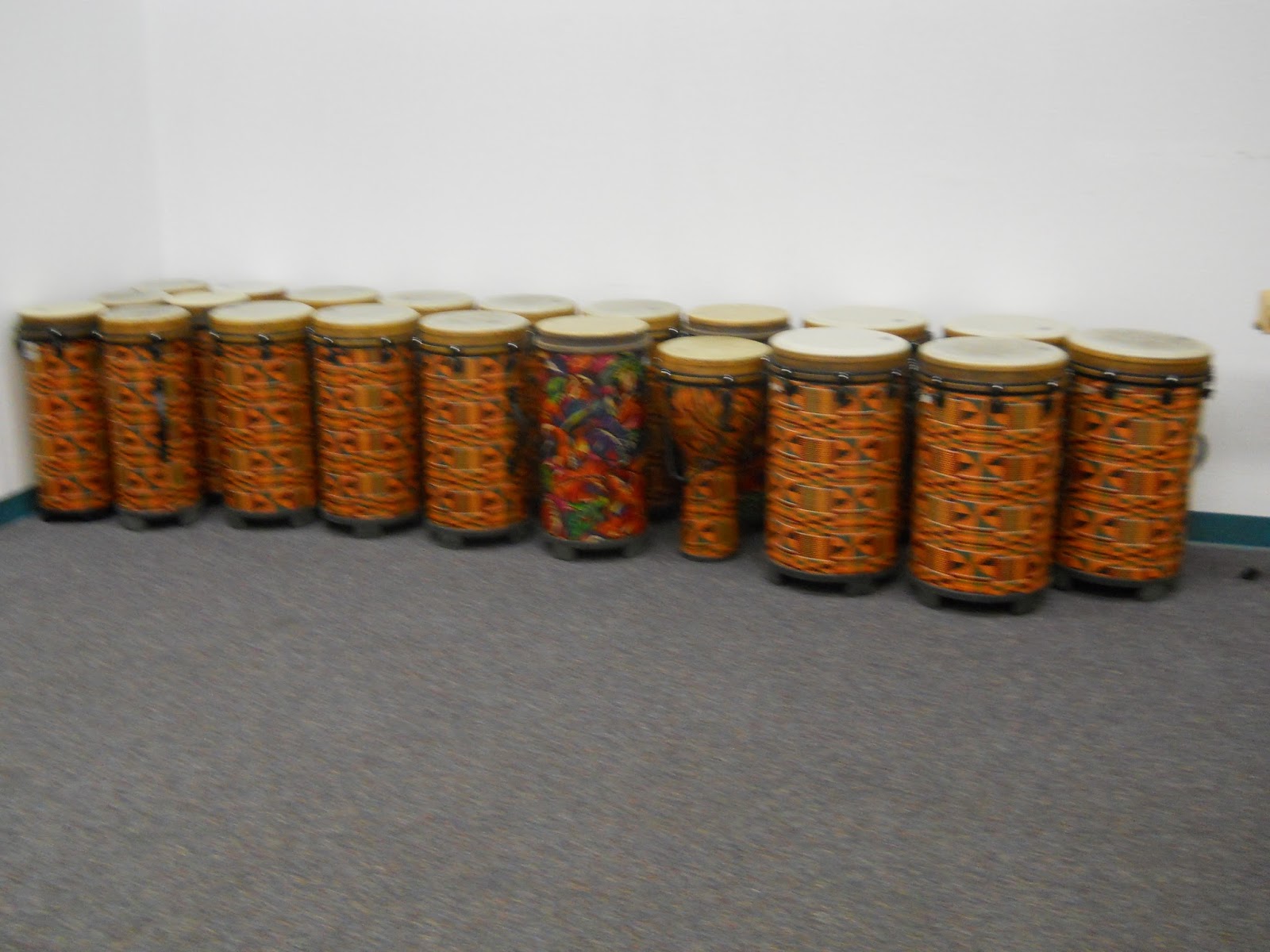
23 drums!  I had just 1 last year and the kids would fight over it.  I'm so blessed to be here!


Lots of boomwhackers!  I would LOVE to figure out a great way to store them so they are standing up on their own and out of the way.  I saw pictures on another blog where the teacher put them in one of those book holders that classroom teacher keep in the front of their classes...I would just have no idea where to find one of those.


News.  Chorus, Orchestra, and General Music.  When I start the Orff ensemble, I will get that up there as well.


I made signs for my doors.  One door is used for entering and one for exiting the room.


Shot of my room from the door you enter from.  You can see my office back there, and 3 storage rooms beyond that.  Again, this room is HUGE.  I'm really blessed to be here!


Another shot of it. This time of the front.


This is what it looks like when you stand in my office and take a picture.


Door and window to my office.

I can't wait to start talking about my adventures in teaching my 2nd year of general music, chorus, orchestra, and Orff!


Wednesday, August 14, 2013

Week 8 - short week!

This week was a short week.  We watched and listened to everyone's research proposals and I learned a lot about some of the topics that were presented.  In one instance, the presentation that studied the correlation between athletics and musicians and why athletes were the most likely candidates to quit music, most intrigued me.  It is a very good topic and a trend that we all see in our schools!  However, I didn't even think to study this!  I would be most interested to see the results that this study would yield were it to go through!

I have learned a lot over the course of my time in this class.  I thought I knew what a research article was until I took this class.  There are so many components and thoughts that go into creating a research study and a research article.  From the review of literature at the beginning, reading all of the previous work that has been done in this field, creating a methodology that may include questionnaires, tests, or other figures we would need to create, to learning APA citation.  I was trained in MLA citation when I was in 11th and 12th grade English in high school.  When I say trained, I mean drilled.  MLA was really drilled into the students at my school and we came out as proficient in MLA.  So to switch from MLA to APA format for this course was a difficult transition.  There were so many minor details!  The detail that confused me the most was that a citation within a paper looked like this: (Witaszek. p. 1) instead of just (Witaszek 1).  That was hard for me to grasp.

I feel as though I have learned a lot about how to conduct a research study and then to format it into a research paper.  Including the APA format, studying how to put together a research paper was interesting.  We had to start with a title page, page numbers, and a running head.  Next came the abstract which was given it's own page.  Then came the introduction.  That confused me as well for a while.  I thought the abstract WAS the introduction but they are two separate things!

After the introduction, we started in on the Review of Literature.  The Review of Literature takes a lot of time because it involves reading articles for the study.  Some studies are small and have only 10-12 articles to read before the researcher feels prepared for the study.  Other researchers might read 20, 30, or 40 articles before being prepared to begin a study!

After the Review of Literature came the Methodology.  I wrote my entire original Methodology in past tense before I realized it should be future tense because I haven't actually conducted the study yet.  So I went back through and changed the Methodology to future tense before handing it in!

In addition, to come up with all the items for the study including questionnaires and tests also takes a lot of research and time by itself!!

Research is time consuming!  I've learned to respect researchers!  I always thought research articles were helpful but I didn't realize JUST how much work went into them!

Sunday, August 11, 2013

Week 7

This week was spent writing the research etude, analyzing the data from the questionnaire that I posted previously, finishing my research proposal paper, and working on the presentation of present.me.  This was a busy week for me as I also moved to a new city and began work at a new school as their new elementary music teacher!

When analyzing the data from the questionnaire that I had previous created, my hypothesis was correct.  I received a completed questionnaire from 39 respondents who I found online through facebook.com.  "Of the 39 participants, 79% were White, 13% were Asian, 5% were Hispanic or Latino, and 3% were Black or African American.  74% of the participants were female, 23% were male, and 3% of the participants did not specify a gender" (Witaszek. p. 3).

I hosted the survey online at surveymonkey.com which enabled the respondents to complete the questionnaire online in about 5 minutes.  I eliminated the question about age since most of the respondents would be in their 20's and because surveymonkey would not allow an 11th question.

I found that many people experienced some stage fright but not many people let it completely hold them back from performing or speaking in front of others. "Many people experience stage fright either when performing on stage (86% of the participants answered with a yes or sometimes when asked about performing, singing, or dancing in front of others) or when speaking in front of others (73% of participants said sometimes or yes when asked about stage fright when speaking in front of others).  However, despite the high percentage of respondents that stated that they sometimes or always experience stage fright, only 25% of the respondents said they tend to seek to avoid performing or speaking in front of people altogether" (Witaszek. p. 7)

I found that pounding of heart, shaking, and sweating of hands and palms were the most common symptoms of stage fright experienced by the respondents.  In addition, listening to music and staring at a point at the far wall were the two most commonly listed coping methods.  
I found that further research should be done in this area.  "Perhaps a study could be conducted in which participants with stage fright are put into treatment groups, each using a different method to cope with stage fright.  Each participant would have to perform or speak in front other others at the beginning and at the end of the trial.  The participants could be instructed to use the method of their treatment group in order to cope with their stage fright and rank their level of anxiety after using the method as opposed the beginning of the trial when they did not use any method at all" (Witaszek. p. 7)


Sunday, August 4, 2013

Week 6 - Methodology

This week, we dived into how to create the methodology sections for our research proposal.  When I began this research proposal, I think I went through about 6 different topics before I settled on the topic of sight singing.  Last week, we created a review of literature that pertained to our topic.  I found that James L. Reifinger Jr. was one of the leading researchers on sight singing in an elementary classroom.  He has done multiple studies on what the best method of sight singing is for young students.

I have set out to replicate his study in order to determine what the best method of sight singing is for my own students in my own classroom.  I have hypothesized that using solfege is the best method.  However I have found research that suggests that singing on a neutral syllable such as "loo" might be better for students because it doesn't cause a cognitive overload.

After I created my review of literature last week, I set out to determine the method in which  I would conduct the study were it to be approved by a research committee.  I determined that Reifinger had a great method.  In his study, he split students into different treatment groups by class.  One treatment group learned sight singing using solfege and patterns that were familiar to them (4-note tonal patterns that had been pulled from songs the students had learned previously).  Another treatment group learned sight singing by using solfege and patterns that were unfamiliar to them.  Another treatment group learned sight singing by using a neutral syllable with patterns that were familiar to them.  And the last treatment group learned sight singing by using a neutral syllable with patterns that were unfamiliar to them.  In his study, he spent 16 lessons developing the sight singing skills in each group.  I proposed, in my study, to spend 21 lessons.  Perhaps a longer time period would yield results different than those of Reifinger's study.

Like Reifinger, I proposed that two outside teachers (his were retired music teachers) grade the recorded pretests, posttests, and retention tests.  This would eliminate any bias that would occur if the teacher that taught the students and knew the students graded the exam.  In addition, two separate teachers who did not converse with each out, would grade the tests without knowing the answers first.  They would determine what notes the students were attempting to sing.  Then the grades of the two teachers would be compared for validity.  (Reifinger found an 89% validity in his 2009 study using this method).  After that, the grades for each treatment group would be compared.

In addition to learned about how to create a methodology section of a research proposal, we analyzed data in excel.  I learned how to find the correlation in excel.  Remember that just because there is a correlation between two items, it doesn't mean that the correlation is positive.  The correlation between two items can be negative as well.  In addition, there can be low, moderate, or even high correlation.  In addition to the Pearson function in excel, I put the items into a scatter plot graph that helped me determine if the correlation was positive or negative and if the correlation was low, moderate, or high.

Sunday, July 28, 2013

Week 5 - Questionnaires and Review of Literature!

This week has included a lot of reading!  I was instructed to create a questionnaire about a music education topic.  The questionnaire could be given to adults because we don't have access to students in a classroom over the summer.  I wracked my brain for a subject and went through many of them before settling on the subjects of stage fright.  I have a lot of friends and family who have dealt with stage fright in various forms over the years.  After settling on the topic of stage fright and possible cures for stage fright, I read Chapter 7: How to Construct a Questionnaire from the text, "Educational Research: Quantitative, Qualitative, and Mixed Methods Fourth Edition" by Burke Johnson and Larry Christensen.

Johnson and Christensen define a questionnaire as "a self-report data-collection instrument that each research participant fills out as part of a research study" (162).  A questionnaire is like a survey in that it allows the participant to answer questions about a certain topic.  There are two different types of questions that might appear in a questionnaire: open-ended questions and closed-ended questions.  An open-ended question is a question that allows the participant to answer freely, like a short answer question.  A closed-ended question provides a set number of answers and the participant must choose one answer.

Johnson and Christensen state 15 principles of Questionnaire Construction:
1) Make sure the questionnaire items match your research objectives.
2) Understand your research participants.
3) Use natural and familiar language.
4) Write items that are clear, precise, and relatively short.
5) Do not use "leading" or "loaded" questions. (A loaded question is "one that contains emotionally charged words" while a leading question is "one that is phrased in such a way that it suggests a certain answer" (166-167)).
6) Avoid double-barreled questions. (A double-barreled questions "combines 2 or more issues or attitude objects in a single item" (168)).
7) Avoid double negatives.
8) Determine whether an open-ended question or a closed-ended question is needed.
9) Use mutually exclusive and exhaustive response categories for closed-ended questions.
10) Consider the different types of response categories available for closed-ended questionnaire items.
11) Use multiple items to measure abstract constructs.
12) Consider using multiple methods when measuring abstract constructs.
13) Use caution if you reverse the wording in some of the items to prevent response sets in multi-item scales.
14) Develop a questionnaire that is properly organized and easy for the participant to use.
15) Always pilot test your questionnaire.

With these 15 principles in mind, I created the following questionnaire about stage fright:


Stage Fright
Hello and thank you for taking the time to fill out this questionnaire.  Everyone deals with stage fright at some point in their life.  Whether it’s the feeling of slight anxiety before you step onto the stage or the experience of chest pain, most people have experienced one of the symptoms once in their life.  Please take a few minutes to fill out the following questions to reflect upon your experiences with stage fright.  Remember, there is no right answer!

1. Do you have stage fright when you sing, dance, or perform an instrument in front of others? (Circle one)
Yes                  Sometimes                   Never

2. Do you have stage fright when you speak in front of other people? (Circle one)
Yes                  Sometimes                   Never


3.  Do you avoid, if at all possible, the chance to perform or speak in front of others? (Circle one)
Yes                  Sometimes                   Never

4. Do you feel uncontrollable anxiety when you perform or speak in front of others? (Circle one)
Yes                  Sometimes                   Never

5. Do you feel like you will lose control when you perform or speak in front of others? (Circle one)
Yes                  Sometimes                   Never

6. On a scale of 1 to 7; 1 being the least and 7 being the highest, please rate the level of anxiety you feel when you perform or speak in front of others.
1                      2                      3                      4                      5                      6                      7


7.  Do you experience any physical symptoms when you perform or speak in front of others?  If so, please circle all that apply:
Dizziness
Sweating of hands/palms
Shaking
Chest pain
Pounding of heart
Numbness
Other (please explain): ___________________________________________________________________________________________________________________________________________________________________________________________________________________________________________________


8.  Which of the following ways to cope with stage fright works best for you (circle one)?
Listening to music before you perform or speak in front of others.
Stretching before you perform or speak in front of others
Meditating before you perform or speak in front of others
Exercise before you perform or speak in front of others
Laugh before you perform or speak in front of others
Imagine the audience in their underwear as you perform or speak in front of others
Visualize success before you perform or speak in front of others
Visualize the words and/or notes in your head while you perform or speak in front of others
Pick a point on the far wall to stare at as you perform or speak in front of others
Pick 3 people in the audience to stare at as you perform or speak in front of others
Other (Please explain): ___________________________________________________________________________________________________________________________________________________________________________________________________________________________________________________


9. Gender (circle one):
Male                                        Female                         Prefer not to Answer

10. Race (circle one):
American Indian or Alaska Native       Asian               Black or African-American    
Hispanic or Latino                               White               Native Hawaiian or Other Pacific Islander
Prefer not to Answer

11. Age:
0-9
10-19
20-29
30-39
40-49
50-59
60-69
70-79
80-89

90-100

Hopefully this survey allows me to gain some insight on the topic of stage fright and the possible cures.  This will allow me to work with my students who are afraid of performing in front of others in order to create a safe environment.

In addition to the questionnaire this week, I was charged with creating a review of literature on the topic of my research study proposal: Sight Singing in an Elementary Music Program.  I really wanted to research this topic because there are so many methods to teaching sight singing.  It would be interesting to see if there was a method that stood out from all the rest.  

I spent a great deal of time researching articles for this project.  I found that James L. Reifinger Jr. is a pioneer in this field and has done a number of studies on this subject.  He worked multiple times with second grade students because he determined that was the grade where most programs began their notation instruction.  He worked with the students multiple times.  In 2009, he worked with the students in determining whether or not patterns that were taken from songs the students had previously knew could be practiced using solfege and that would allow the students a chance to succeed when sight singing.  They took a prettest, posttest, and retention test.  In the tests, the items 1-15 were patterns practiced over a 16 week period and items 16-25 were unfamiliar to the students.  He found that the students did better on the familiar patterns.  This evidence shows that students should practice solfege in the classroom constantly.  The more they practice a certain solfege pattern, the better the student is able to sight sing that pattern!  In addition, in 2012 he did a similar study in second grade.  This time he wondered whether or not solfege was the best tool for students when sight singing or if singing on a neutral syllable such as "loo" would give them a greater chance for success.  In addition, he kept the familiar and unfamiliar patterns in order to further research is previous topic.  He split the students into 4 groups : solfege/familiar, solfege/unfamiliar, loo/familiar, and loo/unfamiliar.  He found that using solfege with familiar patterns once again yielded the best results.  But he also found that using solfege for unfamiliar patterns could sometimes be difficult because it was too much to concentrate on at the same time.  Because of that, using loo with unfamiliar patterns also had its benenfits!

Sunday, July 21, 2013

Week 4

In music therapy and music education, qualitative research is just one of three of the main types of behavior research.  Within the qualitative research genre, there are 4 basic characteristics:

1) noninterventionist - which is the observation in the natural settings,
2) interpretation - which is the interpretation of both EMIC issues (which are those of the participants) and of ETIC issues (those of the writer),
3) highly contextual description - of people and events, and
4) validation of information through triangulation.

The qualitative study utilizes words and narrative in order to tell the story.  According to Phillips, "the main outcome is to present a close-up picture of one participant of a small group of participants in relation to some criterion" (Phillips 83).

According to Phillips, the following are characteristics of qualitative research:
1) Natural Setting - the research takes place in a natural setting such as a classroom or a music therapist's office.
2) Multiple Methods of Data Collection - researchers must seek to build reliability and credibility with the individuals.  Data can be collected in numerous ways including openended observastions, interviews, and documents.
3) An Emerging Process - The research questions can change throughout the study as well as the data-collection process.
4) Multiple Strategies of Inquiry - researchers must use 1 or more strategies of investigation.
5) Fundamentally Interpretive - the researcher interprets the collected data.
6) Holistic View - a broad view.
7) Reflexivity of the Researcher - the study reflects on who the researcher is.
8) Complex, Cyclic Reasoning Process - utilizes complex reasoning.  The thinking is a cyclic process.

According to Phillips, in qualitative research, there are as many as 28 modes of inquiry, but most fall into 1 of 5 categories: narrative, phenomenology, ethnography, case study, and grounded theory.  The 28 genres are usually grouped into one of two broader genres titled: interpretive and critical thinking.

Interpretive Studies are studies that seek "to understand a situation from the perspective of the participant" (Phillips 85).  Narrative, phenomenology, ethnography, case study, grounded theory, and action research all fall within this category.  Critical Thinking are studies "concerned with empowering human beings to transcend the constraints placed on them by race, class, and gender" (Phillips 85).  This broader genre includes feminist, deconstruction, postmodern, popular culture, and critical ethnography.

According to Phillips, data collection of a qualitative study seeks to identify the purposefully selected site or individuals for the proposed study and indicates the types of data to be collected.  There are four types of data: observation, interviews, documents, and audio/visual materials.  To analyze the data that was collected there is a three step process: 1) it is ongoing that involves reflection about the data, questions, and writing memos throughout the duration of the study, 2) it involves open-ended data, and 3) researchers must tailor the data analysis beyond the generic approaches.

The data presented must be reliable and validates.  In order to validate the data, you can either use triangulation (3 analysis types used in the study), member-checking (participants provide feedback to check the accuracy of the data collected), thick description (writes richly so that readers made experience the study), bias clarification (clears any researcher bias), differing perspective (provides a different perspective that counters the theme), prolonged time (spend in-depth time), peer briefing (another person reviews and asks questions about the collected data), and external auditor (someone new to the researcher reviews the project).

Qualitative Research is flexible.  The format of a qualitative study often changes as questions and responses dictate the course of the study.  There are 5 pieces of "machinery," as Phillips calls it, that work behind a qualitative study: 1) Time, 2) Subjectivity, 3) What does not fit, 4) Relationships, and 5) Context.

According to Mertler in Chapter 4: Developing a Research Plan, we are now looking at what is the last part of the planning stage in developing a plan.  We must ask research questions that will help guide our study.  First, the researcher must determine if the study will be qualitative, quantitative, or mixed.  If the researcher chooses to perform a qualitative research study, the study will be guided by only research questions that will most likely be stated throughout the study once they begin to collect data.  But if the researcher chooses to perform a quantitative research study, it will be guides by either researcher questions or hypotheses.  Mertler defines a research question as "the fundamental question inherent in the research topic under investigation."

Mertler confirms what Phillips stated in that the most common qualitative designs used in a study are case studies, ethonographies, and phenomenological studies.